The Gate Before the Scales: Why Choosing an SPV’s Address Depends on Where Its Notes Settle
October 6, 2026

Valentyn Burianov, Chief Executive Officer, CIRA · CEO Column · October 2026
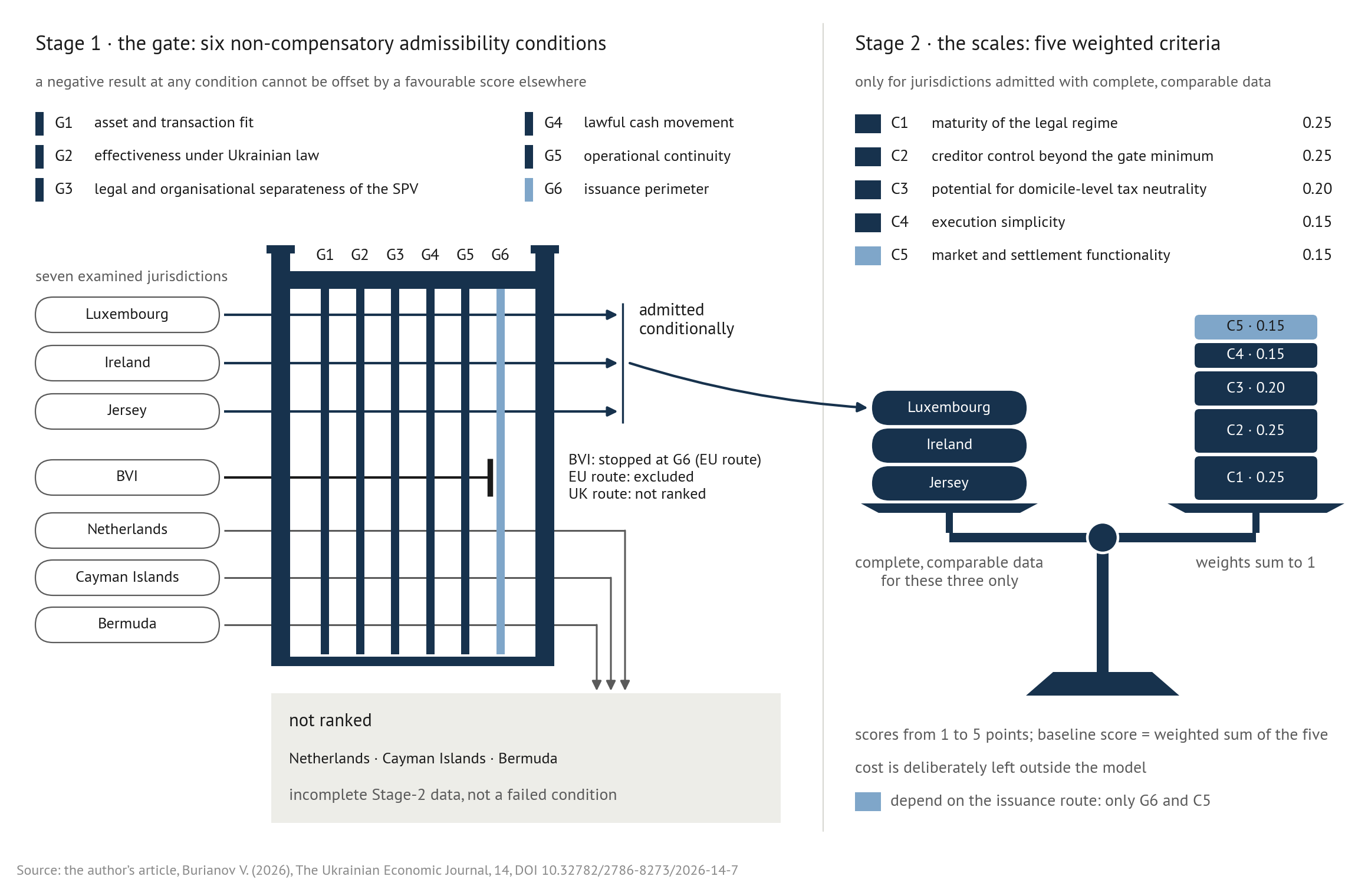
The conventional way to choose a jurisdiction for a cross-border deal is a weighted matrix: criteria with weights, scores in points and a total that decides first place. It goes wrong not in its arithmetic but in a silent assumption: that every defect has a price in points. Two consequences follow from that. The first is compensation: a high tax score offsets a defect that makes the deal impossible to complete. The second is false universality: one ranking for every issuance route, when the answer depends on where the notes are placed and how they settle. In an article just published I propose a different order: the gate first, then the scales.
The previous issue stayed inside Ukraine’s closed circuit; this one asks how a Ukrainian producer reaches foreign capital through its wall. One of the ways out is a cross-border securitisation of future export receivables through a special-purpose vehicle (SPV) registered abroad. That wall reappears here as one of the gate’s conditions – lawful cash movement. As at the article’s data-fixing date of 22 July 2026, the Law on Currency and Currency Transactions and the National Bank of Ukraine’s wartime restrictions required a bank-confirmed payment path compatible with export-proceeds supervision. Directing buyers to pay into a foreign account was not sufficient. Supervision of export proceeds in wartime is a feature of the regime, not an obstacle that a score on some other criterion can buy out.
Six non-compensatory admissibility conditions make up the gate: asset and transaction fit, effectiveness under Ukrainian law, legal and organisational separateness of the SPV, lawful cash movement, operational continuity and the issuance perimeter. Nothing is weighed at the gate: a defect that stops the deal cannot be offset by any counterweight on the scales. A condition can also be passed conditionally, which leaves a precondition to be met before the transaction completes. And the status “not ranked” means that comparable data are missing, not that a condition has failed.
The model is applied to an illustrative transaction – a securitisation of the future iron-ore export receivables of a Ukrainian producer. The seven jurisdictions examined come to the gate. Luxembourg, Ireland and Jersey are admitted conditionally. The Netherlands, the Cayman Islands and Bermuda are not ranked because they lack comparable data. The British Virgin Islands (BVI) are excluded under the EU route (an issue for EU-regulated investors): at the data-fixing date they were on the EU list of high-risk anti-money-laundering jurisdictions, so they fail the issuance-perimeter condition. Under the UK route the same condition does not stop the BVI (it is a conditional pass), but they are not ranked either. More telling still: all seven meet the conditions of effectiveness under Ukrainian law and lawful cash movement only conditionally, and no foreign address changes that.
Beyond the gate stand the scales, and only those that passed it with complete, comparable data step onto them: Luxembourg, Ireland and Jersey. They are weighed on five criteria: the maturity of the legal regime and creditor control beyond the gate minimum carry a weight of 0.25 each; the potential for domicile-level tax neutrality, 0.20; execution simplicity, 0.15; and market and settlement functionality, 0.15. Scores run from 1 to 5 points, and the weights reflect the priorities of this particular transaction. Cost is deliberately left outside the model: it is not comparable across jurisdictions and varies with the parameters of the specific transaction.
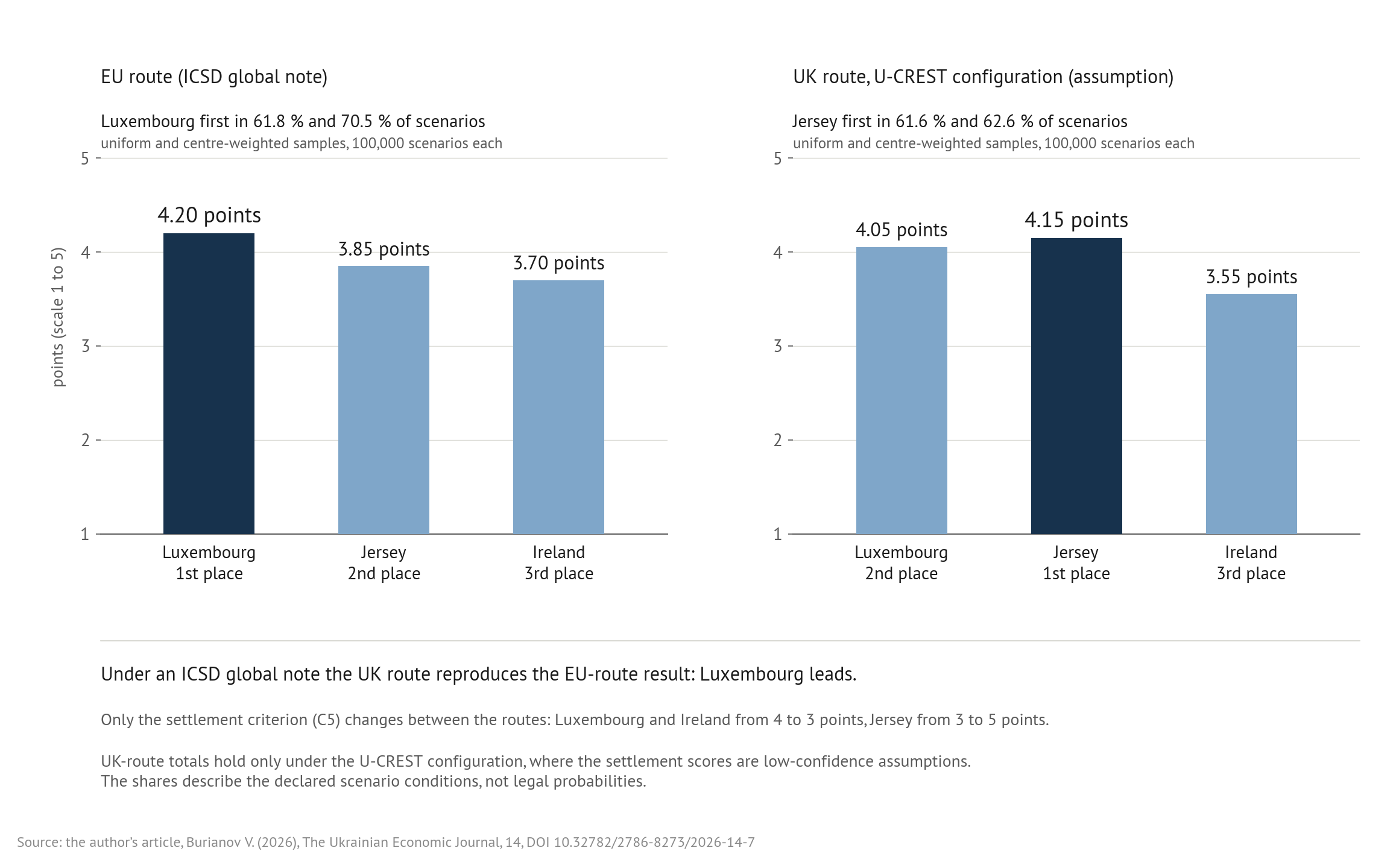
Under the EU route the baseline scores are: Luxembourg 4.20 points, Jersey 3.85 points and Ireland 3.70 points. Luxembourg earns 5 points each for the maturity of its legal regime and for its statutory creditor control beyond the gate minimum. Jersey’s advantage lies in execution simplicity: a Luxembourg or Irish SPV remains subject to the risk-retention and reporting requirements of Regulation (EU) 2017/2402, whereas Jersey’s consent-based regime is lighter – provided that no party to the securitisation is established in the EU. The potential for domicile-level tax neutrality is scored the same for all three, at 4 points: each regime is materially favourable but conditional, and the equal score reflects comparable potential, not identical outcomes. The tax score that a weighted matrix habitually leans on to offset defects decides nothing here.
To test whether first place holds up, the model runs 100,000 scenarios in each of two samples, varying the weights within ±20 % and, at the same time, the medium- and low-confidence scores within one point. Under the EU route Luxembourg comes first in 61.8 % of scenarios in the uniform sample and in 70.5 % in the centre-weighted one. These first-place shares describe the conditions declared for the scenarios, not legal probabilities.
Now to universality. The issuance route is a separate parameter in the model, but only the issuance-perimeter condition and the settlement criterion depend on it. The UK route – a London Stock Exchange listing for UK institutional investors – does not lighten the EU-law duties of a Luxembourg or Irish SPV: those duties attach to the vehicle regardless of the listing venue. If the notes are issued as a global note held in an international central securities depository (ICSD), settlement is domicile-neutral, and the UK route reproduces the EU-route result: Luxembourg remains in first place.
The leader changes only under the assumed U-CREST configuration – the one on which the article assesses the UK route: the notes of a Jersey SPV would settle directly in CREST, while those of a Luxembourg or Irish SPV would settle through a CREST depositary interest. In this configuration Jersey moves ahead – 4.15 points against 4.05 points for Luxembourg. But direct participation in CREST requires the operator to accept the particular issue, so the article codes those settlement scores as low-confidence assumptions and keeps Luxembourg as the baseline choice. Until that acceptance is confirmed, the settlement mechanism is a condition of completing the transaction rather than a driver of the baseline ranking.
A foreign address does not protect the deal on its own: registering the SPV abroad does not remove assets from the originator’s insolvency estate. Without legal confirmation of an effective assignment of ownership rights, or of the possibility of enforcement, such a structure is more accurately described as structured future-flow financing than as securitisation. A public case from April 2026, analysed in the article, illustrates the general rule: under either route, the originator’s going-concern status, eligible-receivable generation and backup servicing have to be confirmed before the SPV’s country of registration is chosen. For a Ukrainian exporter, this changes the question itself: not “which jurisdiction tops the table” but “which structure survives the test of Ukrainian law, the chosen issuance route and the settlement system”. The answer is a list of checks, and every score behind it carries its source, date and confidence level.
I see the model’s value in the order of steps it imposes: it shows what has to be established before a country is chosen, rather than letting a ranking stand in for it. It is a tool that structures due diligence, not a legal opinion on a specific transaction; tax, accounting, sanctions and conflict-of-laws effects, as well as the impact on regulatory capital, have to be analysed separately. Ukrainian exporters will be raising foreign capital during the war and in the rebuilding after it, and each time the deal will turn not on the address that tops the table but on whether the structure can be carried through to completion. The scales will have their say – but only on the far side of the gate.
The full text of the article, with its tables and sources: Burianov V. “Choosing an SPV jurisdiction for cross-border securitisation”, The Ukrainian Economic Journal, No. 14, 2026, pp. 54–60 (published in English). DOI: 10.32782/2786-8273/2026-14-7. A longer discussion is published on my blog Amplifying Value.
The CEO Column is the author’s personal analytical view. It is not a credit rating, a rating action or an official position of Credit Intelligence Rating Agency LLC; the Agency’s rating decisions are taken solely by its Rating Committee. The Column does not comment on CIRA’s rating actions, the Agency’s clients or potential rated entities.