.png)
Communicating Vessels with the Tap Shut: Inside a Closed Circuit the Risk-Free Rate Splits in Two
September 4, 2026

This is the first issue of the CEO Column. I will be writing here about finance and markets in my own name – the way I am used to writing in my blog and my academic work: with data in place of loud claims, and with honest caveats in place of certainty.
I decided to start with the claim I have grown tired of debating at academic seminars and in business conversations alike: that the National Bank of Ukraine administratively sets the policy rate, tames inflation and draws the government yield curve by decree. The push came from Aswath Damodaran’s 2024 post on the Fed – the case that a central bank is far more a follower of markets than a setter of them, a rooster whose crowing the yard mistakes for the cause of sunrise.
In truth that claim glues three different statements into one sentence: that by raising the key policy rate the NBU has (1) set the rate of inflation, (2) set the yield on government bonds and (3) set the cost of corporate credit. In the paper behind this column we test each statement separately on Ukrainian data. None survives the test.
Start with the rate itself. If the central bank reacts to macro conditions rather than setting them, we should be able to explain the policy rate from the simplest pair of those conditions – lagged inflation and lagged real growth. We can: a two-variable regression explains 54 % of the rate’s variation over the long 2002–2025 history, 62 % in the cleanest peacetime window of 2015–2021, and 73 % in wartime 2022–2025. The narrower the window and the tighter the institutional discipline, the more the rate behaves like a reaction rather than an independent decision. Of course, the model does not beat the naive “rate stays unchanged” rule on next quarter’s level – but it gets the direction of the next move right about twice as often as naive persistence does.
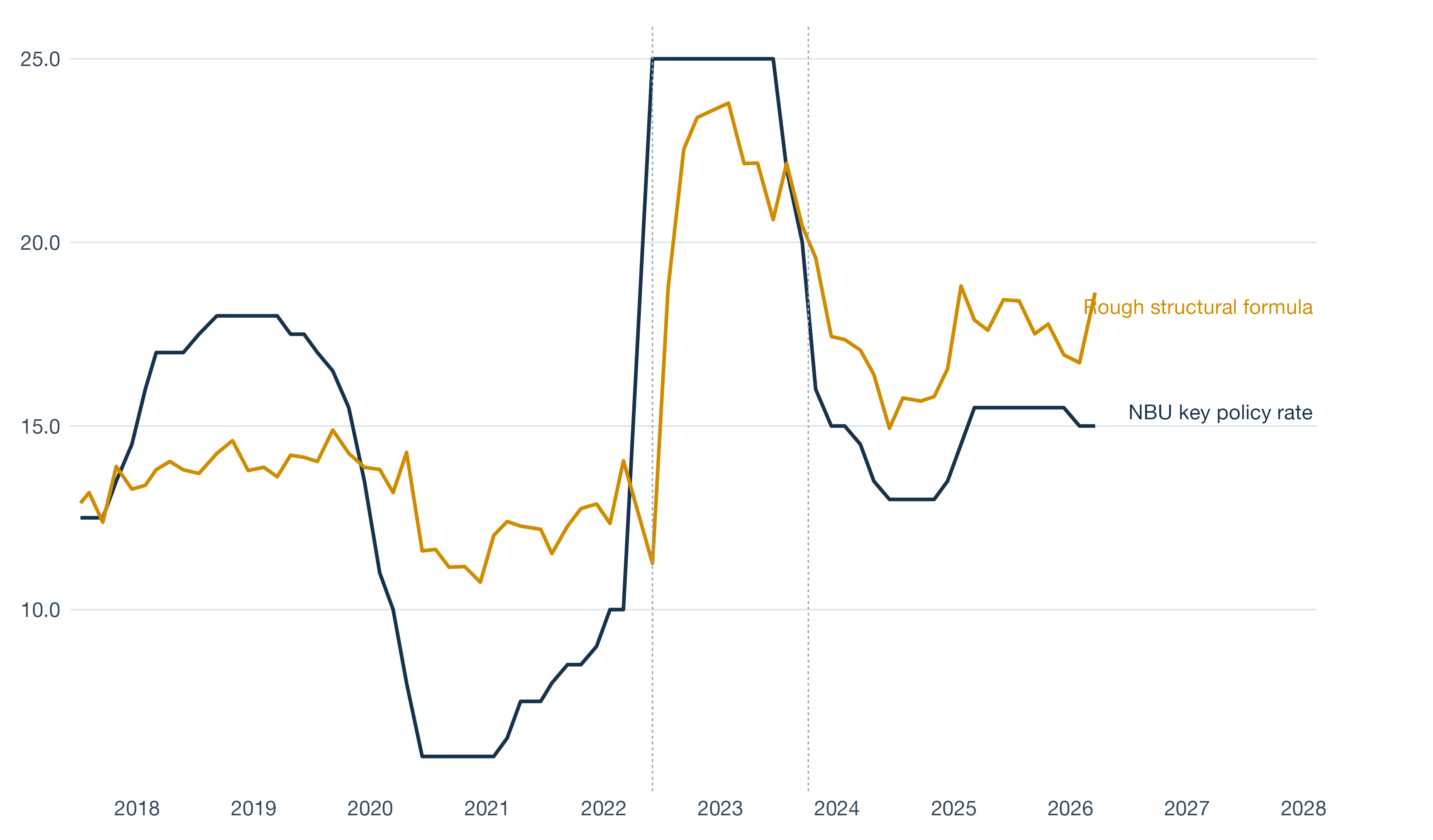
Then comes the question of how far the policy signal actually reaches. The link is tightest at the overnight interbank rate: UONIA follows the policy corridor with R² ≈ 0.96 – the only price in the system the NBU literally sets, and one nobody outside the interbank market trades. With every step outward the signal loosens: before the war the short end of the government curve responded to the policy rate at β = 0.77, the 3–5-year bucket at just 0.31, and bank lending and deposit rates passed the change through only partially and with a lag. The telling episode is June 2022: having raised the rate to 25 %, the NBU publicly waited for bond yields and deposit rates to catch up. Administrators don’t wait for a price they set themselves.
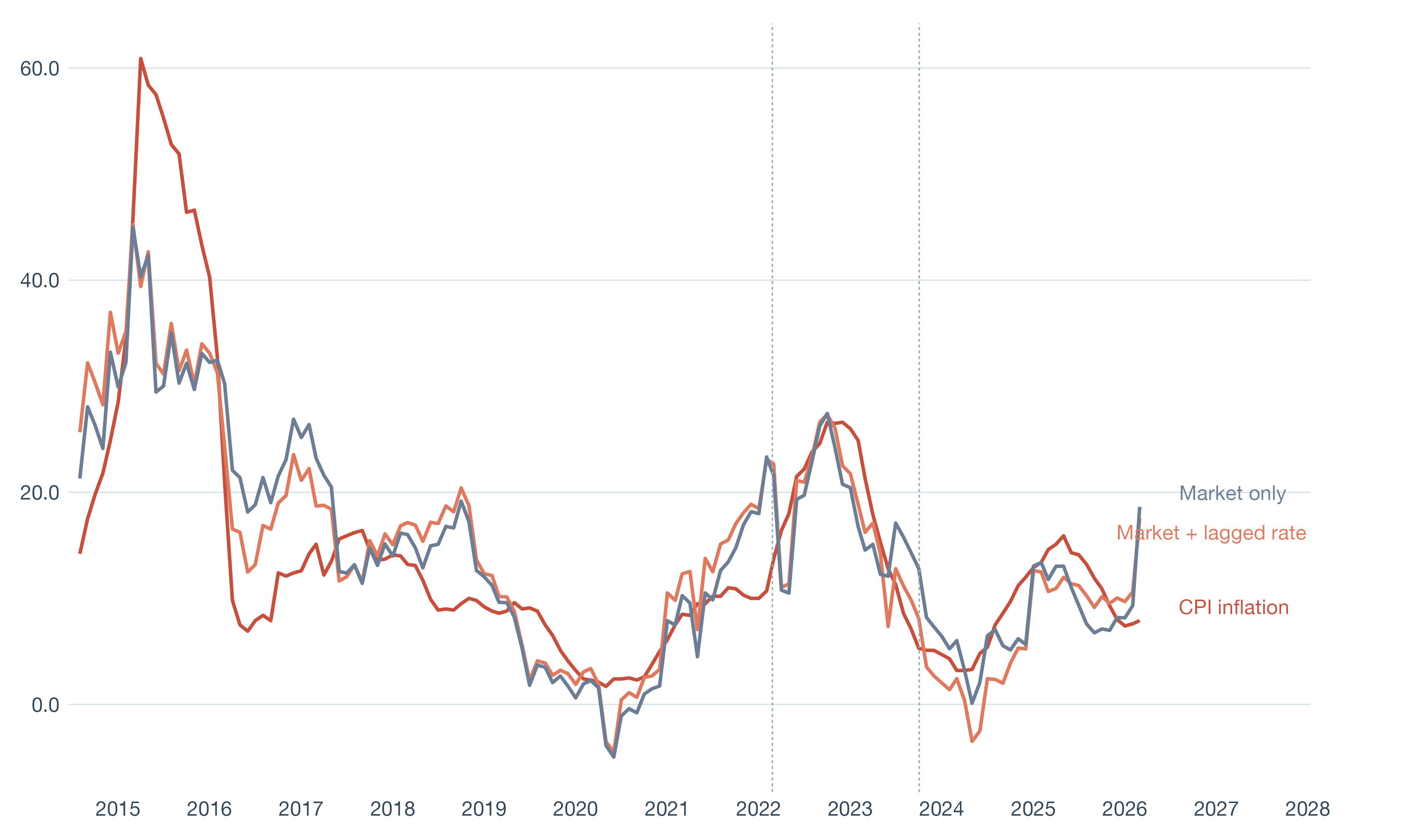
Finally, inflation – the centrepiece myth. A market-only model with no monetary variable at all – lagged producer prices, hryvnia depreciation, household inflation expectations – explains 64.2 % of the variation in consumer inflation over 2014–2026. Adding the lagged policy rate lifts the explained share to 68.3 %, and the rate enters with a negative, statistically significant coefficient. The contribution of monetary policy is real – but it is a thin lagged layer on top of an inflation level that is born in the market.
The conclusion is deliberately less complimentary than the dominant public narrative, and more useful for it. I read the NBU as a disciplined, reactive institution: its signal is tightest in the narrow overnight zone, and beyond it – partial, lagged and widely overstated. For how we talk about macro stability in wartime and on the way to post-war reconstruction, the practical lesson is simple: the market sets the rate, and the regulator’s task is to be disciplined enough not to obstruct it. The yard, of course, will go on crediting the rooster with the sunrise. But the rooster doesn’t make the dawn – it only accompanies it.
The full version of this argument, with the models and charts, is on my blog Amplifying Value. The academic write-up (in Ukrainian) is published in Efektyvna Ekonomika, No. 5, 2026. DOI: 10.32702/2307-2105.2026.5.146.
The CEO Column is the author’s personal analytical view. It is not a credit rating, a rating action or an official position of Credit Intelligence Rating Agency LLC; the Agency’s rating decisions are taken solely by its Rating Committee. The Column does not comment on CIRA’s rating actions, the Agency’s clients or potential rated entities.