Wartime currency restrictions served their purpose as a crisis-management tool in 2022, but over the past four years, they have cost the state approximately $9–10 billion—a figure that continues to rise each year.
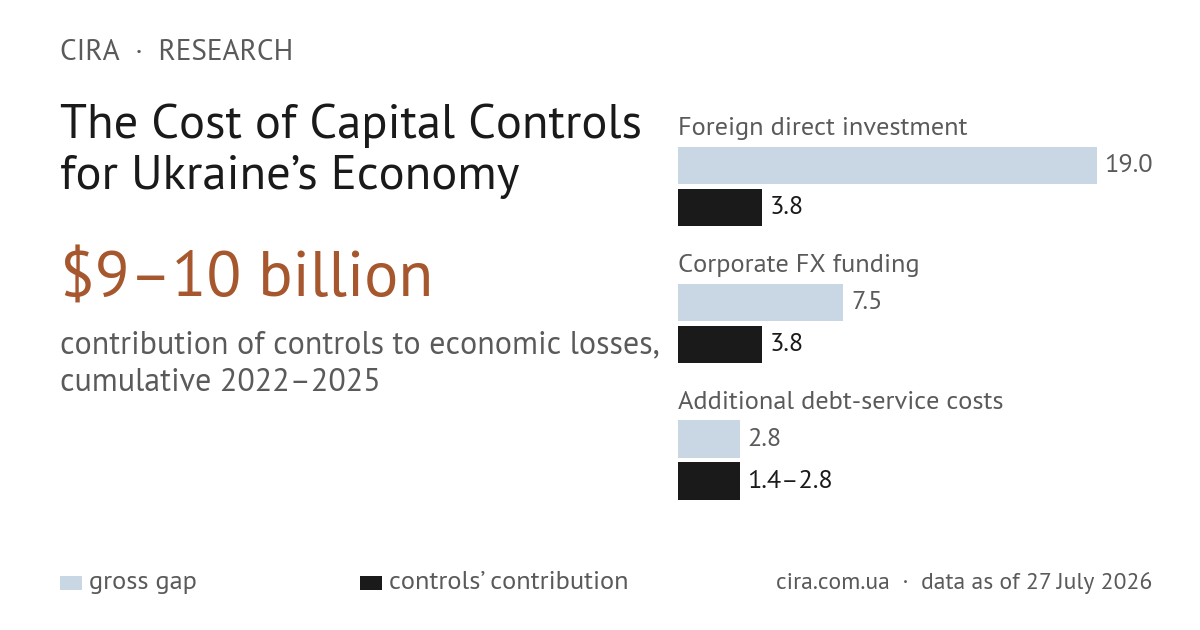
• Currency restrictions cost the state approximately $9–10 billion between 2022 and 2025. This is the direct impact of the restrictions: about $7.6 billion in unrealized capital and $1.4–2.8 billion in additional budget expenditures for debt servicing.
• The gross gap is wider—approximately $26–27 billion in unrealized capital: a $19 billion gap in foreign direct investment and $7.5 billion that companies failed to raise on the international bond market. This was caused by both the war and the restrictions, so each component is included in the total with a conservative estimate.
• Each year the regime remains in place costs about 31 billion UAH ($0.7 billion) in additional costs for servicing hryvnia debt and $0.6–2.1 billion in unrealized GDP growth.
• As long as the regime is in effect, Ukrainian assets are valued 12–21% lowerthan they would be without it. This is a valuation effect, not an annual flow.
• It is restrictions, not just the war, that drive up costs. S&P has not granted Ukraine any increase in transfer or convertibility ceilings – Ukraine ranks among 42 out of 143 sovereigns; 78% of surveyed executives state that these restrictions harm investment attractiveness (European Business Association).
The restrictions introduced in February 2022, combined with external official financing, helped preserve reserves and prevent uncontrolled devaluation. However, the initial justification for these measures has largely been exhausted: with reserves at historically high levels, the regime is becoming increasingly costly for the state. Its primary cost is not the capital currently locked within the country, but the capital that never entered: investors factor in the inability to exit freely before committing. In CIRA’s view, the optimal approach is not to maintain the status quo or to lift restrictions all at once, but to implement a phased, managed removal of restrictions for new capital, guaranteed with free exit rights.
This review does not attribute the entire gap to the restrictions. First, it measures the gross gap—the total shortfall resulting from both the war and the restrictions combined—and then applies a conservative coefficient to each component to show both the gross value and the specific contribution of the restrictions. For foreign direct investment, this coefficient is 0.20, the lowest of the three, as physical asset decisions are dominated by the war. For corporate foreign currency financing, it is 0.50, as the sovereign and major issuers underwent restructuring in 2022–2024, meaning the market would have been largely closed even without the restrictions. For the budgetary component, the coefficient ranges from 0.50 to 1.00, which accounts for the range in the final figures.
The foreign direct investment gap was calculated using the synthetic control method: a "synthetic Ukraine" was constructed from comparable countries that most closely mirrored Ukraine’s trajectory prior to 2022. The estimate was verified using alternative econometric methods, a placebo test, and a leave-one-out cross-validation approach; all methods converge on a scale of $12–21 billion. This is a reliable estimate of the scale rather than a precisely measured value, which is why the review presents ranges throughout rather than a single figure.
Two independent indicators point to the impact of the restrictions. The pricing indicator: the transfer and convertibility ceiling is the limit above which rating agencies generally do not rate a country's companies, reflecting the specific risk that the state will block currency conversion and transfers. In 101 out of 143 sovereigns, this ceiling is higher than the sovereign rating; Ukraine is among the 42 with no such uplift. The insurance market prices inconvertibility separately from war risk: MIGA covers it as a distinct risk category with an average premium of about 1% of the insured amount per year.
The stated indicator: 78% of surveyed executives believe that currency restrictions negatively affect Ukraine’s investment attractiveness, with the question posed independently of war and security concerns.
The difference between these two types of risk is practical: physical war risk is independent of restrictions, so the inconvertibility premium will not be removed by victory or reserves, but only by lifting the restrictions.
Restrictions do not cancel obligations; they accumulate them. The National Bank itself estimates the potential demand for foreign currency for transactions currently subject to restrictions at approximately $47 billion for 2026–2027; of this, about $19 billion represents payments that are already past due. Current easing measures are not clearing this backlog: of the $1,271 million in limits established for "new money," only $707 million has been utilized. Against a $47 billion backlog, this is more of a crack in the door than an opening.
On August 10, 2026, the NBU Board adopted Resolution No. 90—the largest package of currency restriction easing since the start of the full-scale invasion, effective August 11. The package focuses on retail transactions: the limit for purchasing non-cash foreign currency increased from 50,000 to 200,000 UAH per month, and within this limit, the purchase of foreign securities is now permitted. For businesses, cash and card limits have been raised, an "additional" limit has been introduced, and it is now permitted to transfer "investment" and "additional" limits to related group companies.
This does not change the review’s conclusions. The National Bank explicitly states that the list of transactions permitted under this stimulatory currency liberalization remains unchanged, and the exit regime for foreign portfolio and equity capital remains as described above. The package actually exacerbates the asymmetry discussed in the review: a resident can now purchase 200,000 UAH worth of foreign securities monthly, while a non-resident who invested in government bonds still has no guarantee of repatriating their principal. At the same time, the updated NBU macro-forecast, which already accounts for this package, projects international reserves to grow to nearly $70 billion in 2026—meaning the prerequisites for the next, investment-focused step have only strengthened.
Source: NBU press release dated August 10, 2026; NBU Board Resolution No. 90 dated 08/10/2026.
A phased, managed removal based on the proven Icelandic model, with a clear separation between new and old capital. Phase 1: capital entering after the opening date is credited to segregated accounts with a guaranteed right of free exit. Stage 2: auction-based clearing of "legacy" capital via managed tranches – the pace and total volume are controlled by the NBU. Stage 3: full convertibility subject to sustained adherence to thresholds – reserves exceeding five months of imports and a capital adequacy ratio above 100%.
This is safe because "new money" creates its own currency backing: the exit guarantee is limited to the volume of currency that this capital brought in. The legacy portfolio capital that could have exited simultaneously with the launch of Stage 1 is small – $0.4 billion in non-resident government bonds, less than 1% of reserves. And the outflow that was feared has already occurred in 2022.
The timing for the decision is set by the calendar: by the end of August 2026, the Ukrainian side must conduct an inventory of foreign exchange measures coordinated with the IMF. A separate regime for new capital does not require changing exchange rate policy or unblocking legacy capital, so it does not contradict any commitments under the program.
"The main cost of restrictions is not the capital locked inside the country, but the capital that never entered."
On methodology. The foreign direct investment gap was estimated using three independent methods – synthetic control, synthetic difference-in-differences, and benchmarking against international studies on liberalization; they converge on $12–21 billion. The 170 basis point premium is a scenario-based figure calibrated to current Fitch and Moody's ceilings, rather than a measured effect on government bond yields. The 12–21% discount in asset value mirrors the 13–26% increase in present value that a 170–254 basis point reduction in the cost of capital would provide. A range instead of a single figure is a deliberate choice: the review's conclusions must hold up even under the strictest skepticism regarding attribution.
Important information. This material is a thematic analytical study and does not constitute a credit rating, rating action, forecast, or rating review, and is not part of CIRA's rating activities as defined by the Law of Ukraine "On Rating" No. 3981-IX; it was prepared as part of the agency's additional services (assessment of economic trends and other general data analysis, Part 9 of Article 15 of the Law), separate from rating activities. It expresses the Agency's opinion, not a statement of fact, and does not constitute investment, legal, or tax advice, or an offer or recommendation to buy, sell, or hold any financial instruments. The material is based on sources that CIRA considers reliable; the Agency does not guarantee their completeness or accuracy. The estimates are scenario-based and sensitive to the assumptions stated in the review. Data cutoff date: July 27, 2026. Reproduction is permitted provided that CIRA is cited. Credit Intelligence Rating Agency LLC, EDRPOU 45564435, Kyiv, Voznesenskyi Uzviz, 3/5. © 2026. All rights reserved.
.png)